Saturday, December 24, 2011
Tuesday, December 20, 2011
Tuesday's Dragon
Kazul
Also known as: The King of the Dragons
Kazul, a dragon of the Mountains of Morning, is quite a remarkable lady. Especially considering that she is the king of the dragons.
To most of us, this might seem a bit unusual. But to the dragons who live in the world of The Enchanted Forest Chronicles, as created by Patricia C. Wrede, it makes perfect sense for a lady dragon to be king. After all, the office of King is just that . . . an office.
And besides, no one wants to be Queen. That's a boring job!
Kazul is remarkable for other reasons besides her rule. She's a doting grandmother, of one thing. She's also a fair and open-minded sort, willing to give folks a chance to prove themselves. For instance, when a discontented princess named Cimorene traveled all the way from her kingdom of Linderwall to the Mountains of Morning and asked to become a Dragon's Princess, some of the other dragons wanted to eat her. After all, no proper princess would come offering herself to a dragon! And if she's not proper, what good is she?
But Kazul decides to give Cimorene a try. After all, Cimorene is a decent baker and scholar.
"I like cherries jubilee," says Kazul, when the other dragons question her decision. "And I like the look of her. Besides, the Latin scrolls in my library need cataloguing, and if I can't find someone who knows a little of the language, I'll have to do it myself" (p. 19).
Yet another way in which Kazul is unusual. Who ever heard of a dragon with a library? Oh, she has a proper hoard too, complete with magic rings and suits of armor and even geni-filled bottles (don’t open those!). But a library?
A literary dragon is exactly suited to Princess Cimorene's tastes . . . and Cimorene's cherries jubilee is suited to Kazul's. So they make a fine pair, the two of them and eventually become friends.
Not that Cimorene ever becomes too comfortable with Kazul. After all, even a friendly dragon is a dragon and must be treated with utmost respect! And there's always the fire to be considered. A wise princess must take every precaution, including researching an anti-fire spell to protect herself . . .
It turns out to be a good thing Cimorene took the time for this spell. Dragon-sneezes are, well, nothing to sneeze at! And when Kazul gets a whiff of some deadly dragonsbane--just a whiff, mind you--she is plummeted into a violent illness, complete with sneezing attack, that would have incinerated Cimorene in a moment without that protective spell!
That sickness is almost enough to setback Kazul's future as the king of the dragons. For just when she falls down ill, word comes that the current king has been poisoned with a heavy dose of dragonsbane in his coffee. A new king must be selected! And Kazul, sick or not, is determined not to miss out on her chance.
But I hate to give away plot points. So you should read Dealing with Dragons and the subsequent Enchanted Forest Chronicles to learn more about Kazul on the dragon who live in the Mountains of Morning.
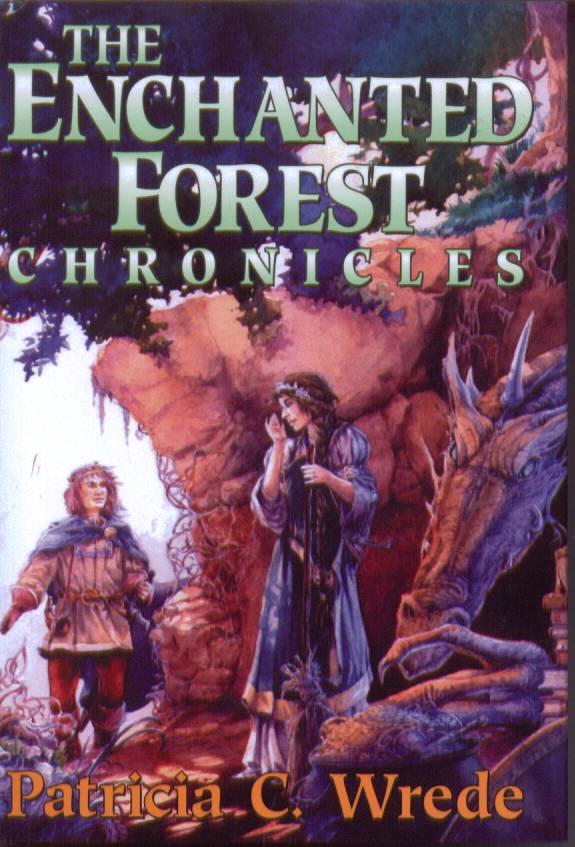
Kazul has found her way into several fun artistic interpretations. The Enchanted Forest Chronicles have been popular enough to merit several reprintings, which mean lots of covers! This one is my personal favorite (and the cover on the copy I own):
You may recognize the style of the brilliant Trina Schart Hyman, my all-time favorite illustrator (of St. George and the Dragon fame). I love her intelligent, possibly a little grumpy, but benevolent depiction of Kazul with her claws curved lovingly around a serving of chocolate mousse (Cimorene's other cookerly talent).
Here's a more recent cover:
And the image seen above but in cover format:
And here's a cover for a four-in-one anthology:
That one has my vote for the scariest depiction of Kazul.
Dealing with Dragons has even been translated into Hebrew! Check out this fun cover:
I also found this interest fan-art of Kazul and Cimorene:
Evil: 0
Kazul is a dignified, but good dragon. Treat her with proper respect, and you'll be fine.
Scariness: 7
Not scary to her friends . . . but dishonest wizards and foolish heroes had better watch out!
Poison: 0
Not poisonous. But pretty hot fire!
Hoard: 10
She gets a 10 because not only does she have all the classic jewels and gems (rooms of them!), she also has a library. Enough said.
Cleverness: 9
Kazul is a very clever and intelligent king.
Also known as: The King of the Dragons
Kazul, a dragon of the Mountains of Morning, is quite a remarkable lady. Especially considering that she is the king of the dragons.
To most of us, this might seem a bit unusual. But to the dragons who live in the world of The Enchanted Forest Chronicles, as created by Patricia C. Wrede, it makes perfect sense for a lady dragon to be king. After all, the office of King is just that . . . an office.
And besides, no one wants to be Queen. That's a boring job!
Kazul is remarkable for other reasons besides her rule. She's a doting grandmother, of one thing. She's also a fair and open-minded sort, willing to give folks a chance to prove themselves. For instance, when a discontented princess named Cimorene traveled all the way from her kingdom of Linderwall to the Mountains of Morning and asked to become a Dragon's Princess, some of the other dragons wanted to eat her. After all, no proper princess would come offering herself to a dragon! And if she's not proper, what good is she?
But Kazul decides to give Cimorene a try. After all, Cimorene is a decent baker and scholar.
"I like cherries jubilee," says Kazul, when the other dragons question her decision. "And I like the look of her. Besides, the Latin scrolls in my library need cataloguing, and if I can't find someone who knows a little of the language, I'll have to do it myself" (p. 19).
Yet another way in which Kazul is unusual. Who ever heard of a dragon with a library? Oh, she has a proper hoard too, complete with magic rings and suits of armor and even geni-filled bottles (don’t open those!). But a library?
A literary dragon is exactly suited to Princess Cimorene's tastes . . . and Cimorene's cherries jubilee is suited to Kazul's. So they make a fine pair, the two of them and eventually become friends.
Not that Cimorene ever becomes too comfortable with Kazul. After all, even a friendly dragon is a dragon and must be treated with utmost respect! And there's always the fire to be considered. A wise princess must take every precaution, including researching an anti-fire spell to protect herself . . .
It turns out to be a good thing Cimorene took the time for this spell. Dragon-sneezes are, well, nothing to sneeze at! And when Kazul gets a whiff of some deadly dragonsbane--just a whiff, mind you--she is plummeted into a violent illness, complete with sneezing attack, that would have incinerated Cimorene in a moment without that protective spell!
That sickness is almost enough to setback Kazul's future as the king of the dragons. For just when she falls down ill, word comes that the current king has been poisoned with a heavy dose of dragonsbane in his coffee. A new king must be selected! And Kazul, sick or not, is determined not to miss out on her chance.
But I hate to give away plot points. So you should read Dealing with Dragons and the subsequent Enchanted Forest Chronicles to learn more about Kazul on the dragon who live in the Mountains of Morning.
Kazul has found her way into several fun artistic interpretations. The Enchanted Forest Chronicles have been popular enough to merit several reprintings, which mean lots of covers! This one is my personal favorite (and the cover on the copy I own):
You may recognize the style of the brilliant Trina Schart Hyman, my all-time favorite illustrator (of St. George and the Dragon fame). I love her intelligent, possibly a little grumpy, but benevolent depiction of Kazul with her claws curved lovingly around a serving of chocolate mousse (Cimorene's other cookerly talent).
Here's a more recent cover:
I don't think that's meant to be Kazul. Looks a little too perplexed. Maybe it's Woraug, the evil dragon with designs on the throne who becomes Cimorene's nemesis?
And the image seen above but in cover format:
And here's a cover for a four-in-one anthology:
That one has my vote for the scariest depiction of Kazul.
Dealing with Dragons has even been translated into Hebrew! Check out this fun cover:
A little video-game-y, but fun!Kazul on a scale of 1-10
Kazul is a dignified, but good dragon. Treat her with proper respect, and you'll be fine.
Scariness: 7
Not scary to her friends . . . but dishonest wizards and foolish heroes had better watch out!
Poison: 0
Not poisonous. But pretty hot fire!
Hoard: 10
She gets a 10 because not only does she have all the classic jewels and gems (rooms of them!), she also has a library. Enough said.
Cleverness: 9
Kazul is a very clever and intelligent king.
Friday, December 16, 2011
The Winner!
All right, ladies and gentlemen! The winner for our Name Needed contest is ready to be announced.
For those of you who need updating, the contest was to select a name for a dog character in my upcoming novel, Starflower. The name needed to be Southlands-appropriate and fit for a female hunting/fighting dog, a scruffy gray lurcher.
This is a lurcher, in case you were wondering.
There were so many to choose from, it was almost impossible to pick! But, after great deliberation, the dog has been named. She will be called:
Frostbite.
Huzzah!
This means that Anonymous is our winner. So if Anonymous would please email me, I will be certain he/she receives his/her winnings (a signed copy of Veiled Rose.)
Thank you so much for your participation, everyone! For those of you interested, here were some of my favorite runner-ups:
Firefiend--by Amber
Harefoot--by Jenny
Fearfang--by al
Hemlock--by Elizabeth (Elizabeth Anne! The reverse me!). Also suggested by taylor2taylor74
Stormcloud--by Clara
Ashdust--by Clara
Tala--by Clara and Sister (but it isn't a Southlands sounding name, so I couldn't use it.)
Lyrk--by Maren (again, not a Southlands name, but a great name for a lurcher!)
But there were so many great ones to choose from! Thank you so much for your participation, and keep your eyes open for more name-drawings and contests!
Tuesday, December 13, 2011
Tuesday's Dragon
Smaug
Also called: TrĂ¢gu, The Golden, The Magnificent, The Dragon of Erebor
You knew you would see him on this list eventually. Possibly the most famous dragon of modern literature, Smaug is an essential component of any dragon listing. And with good reason!
Smaug was heavily inspired by the famous dragon in the Beowulf epic and, indeed, so closely resembles that dragon that one could easily call Smaug his "literary descendant." Unlike Beowulf's nemesis, however, Smaug is far more sentient and, therefore, more evil. But just like that dragon, Smaug keeps a vast and fabulous hoard, a pile of gold on which he slumbers amid greedy dreams. And make no mistake, just like his predecessor, Smaug knows every last piece of his hoard!
There are four known dragons who inhabit Tolkien's elaborate and brilliant world of Middle Earth: Ancalagon, Glaurung, Scatha, and Smaug. In the later part of the Third Age of Middle Earth, Smaug is the greatest dragon yet living, possibly the greatest that ever was. With violence and fire, he took the land of Erebor for his own, driving out the dwarves who dwelled in the Lonely Mountain, and stealing all their treasures. He ruled that land and terrorized the inhabitants for two whole centuries before we finally meet him for the first time in Tolkien's first novel of Middle Earth, The Hobbit.
In that book, we see an echo of the Beowulf themes that must have been an enormous influence on Tolkien. We meet his protagonist, the hobbit of the title, Mr. Bilbo Baggins, assuming the role of the runaway slave from the original epic. But that thief slipped by accident down to the dragon's hoard; Bilbo goes on purpose, a reconnaissance mission for the dwarves with whom he is traveling.
Thirteen dwarves, as led by Thorin Oakenshield, solicited Bilbo to be their personal burglar, a useful asset, they feel, on a quest to reclaim their treasures from Smaug's hold. So Bilbo journeyed with them to the Lonely Mountain and is sent at last down to the treasure hold. There he beholds the hoard of Smaug for the first time:
"Bilbo had heard tell and sing of dragon-hoards before, but the splendour, the lust, the glory of such treasure had never yet come home to him. His heart was filled and pierced with enchantment and with the desire of dwarves" (The Hobbit, Chapter XII).
Many artists have painted and sketched their own personal visions of Smaug's treasure trove. My personal favorite is the picture at the top of this page by Greg and Tim Hildebrant. It was in the hardbound copy of The Hobbit that my parents owned when I was growing up. But two of the other most famous versions have been John Howe's:
And Alan Lee's
Definitely starting to feel some dragonish glory now!
Surely with all that treasure to keep track of, the dragon couldn't possibly miss a single cup? Or so, Bilbo reasoned. But no sooner had Bilbo escaped with his purloined goods, and hardly had the dwarves had a chance to admire his achievement, when Smaug awoke.
"He stirred and stretched forth his neck to sniff. Then he missed the cup!
Thieves! Fire! Murder! Such a thing had not happened since he came to the Mountain! His passes description . . ." (The Hobbit, Chapter XII).
So, just like Beowulf's dragon, Smaug comes bellowing forth in full fury. His hide is armor plated and impervious to all harm save on his tender underbelly. But even this has been so crusted over with gems after centuries of sleeping on treasure, that no mere sword can hope to pierce it.
This is Smaug's boast to Bilbo when, after the fire of his first fury passes, he returns to his lair and there meets the hobbit thief. He boasts and even proves his words by rolling over so that Bilbo may see the glorious armor he has accumulated over the years. Only Bilbo, though his eyes are dazzled by the glitter, sees something else as well: A bare patch in the hollow of Smaug's left breast.
And when Bilbo later communicates this message to the dwarves, he is overheard by thrush.
(Hmmm . . . A thrush! Now isn't that just the oddest literary connection? It's been so long since I read The Hobbit, I didn't actually remember that part!)
Anyway, as it turns out, there was a day when the Men of the Lake-town had been able to speak the language of birds. And there is one who still does: Bard the Bowman. When the time comes, and Smaug, in a rage once more, is burning and destroying Lake Town once and for all, the wise thrush comes to him and whispers: "The moon is rising. Look for the hollow of the left breast as he flies and turns above you!"
So Bard shoots his final arrow, a black arrow. And it sinks home.
Thus ends the flaming, furious, dreadful life of Smaug the Magnificent, greatest dragon of the Third Age.
And one can't help but think it was just in time for more reasons than one! Not just for the people of Lake Town or the dwarves. After all, it wasn't long after these events that Sauron rose up from Mordor and summoned all the dark powers to his thrall. What might he have done with an evil as mighty and deadly as Smaug if given half the chance? Interesting speculation . . .
Smaug has found his way into numerous depictions. Many great artists have illustrated him, not to mention the famous illustration rendered by Tolkien himself:
Yes, we have seen Smaug more magnificent. But there really is nothing quite like seeing an author's own interpretation, is there?
Smaug has made his way into Movie World via this 1977 filmadaption:
What a charmer he was back then, eh? Kind of like a scale-covered cat.
Smaug even made it into Video Game World in 2003.
But, of course, everyone is the most excited about the upcoming 2012 feature film of The Hobbit.
Though I can't help but wonder if we'll see any of Smaug in this part 1 movie? We might not get much Smaug-ishness until 2013 when part 2 releases. In the meanwhile, we do know that Smaug will be voiced by the marvelous Benedict Cumberbatch.
If you have seen him in his Sherlock Holmes role you know he has the perfect voice for a dragon! I'm excited. You should be as well.
Smaug on a scale of 1-10
Evil: 9
Smaug is a satisfyingly and wonderfully evil villain!
Scariness: 10
I can only remember one dragon who ever scared me more! (More on that one later.)
Poison: ?
I can find no references to Smaug being poisonous.
Hoard: 10
A sublime hoard that includes mithril silver and the dwarves' brilliant Arkenstone.
Cleverness: 4
I'm not giving him more than 4. After all, he did roll over and show Bilbo his weakness. Seriously, Smaug? After centuries of people wanting to slay you? You've gotten to comfortable in your scariness.
Also called: TrĂ¢gu, The Golden, The Magnificent, The Dragon of Erebor
You knew you would see him on this list eventually. Possibly the most famous dragon of modern literature, Smaug is an essential component of any dragon listing. And with good reason!
Smaug was heavily inspired by the famous dragon in the Beowulf epic and, indeed, so closely resembles that dragon that one could easily call Smaug his "literary descendant." Unlike Beowulf's nemesis, however, Smaug is far more sentient and, therefore, more evil. But just like that dragon, Smaug keeps a vast and fabulous hoard, a pile of gold on which he slumbers amid greedy dreams. And make no mistake, just like his predecessor, Smaug knows every last piece of his hoard!
There are four known dragons who inhabit Tolkien's elaborate and brilliant world of Middle Earth: Ancalagon, Glaurung, Scatha, and Smaug. In the later part of the Third Age of Middle Earth, Smaug is the greatest dragon yet living, possibly the greatest that ever was. With violence and fire, he took the land of Erebor for his own, driving out the dwarves who dwelled in the Lonely Mountain, and stealing all their treasures. He ruled that land and terrorized the inhabitants for two whole centuries before we finally meet him for the first time in Tolkien's first novel of Middle Earth, The Hobbit.
In that book, we see an echo of the Beowulf themes that must have been an enormous influence on Tolkien. We meet his protagonist, the hobbit of the title, Mr. Bilbo Baggins, assuming the role of the runaway slave from the original epic. But that thief slipped by accident down to the dragon's hoard; Bilbo goes on purpose, a reconnaissance mission for the dwarves with whom he is traveling.
Thirteen dwarves, as led by Thorin Oakenshield, solicited Bilbo to be their personal burglar, a useful asset, they feel, on a quest to reclaim their treasures from Smaug's hold. So Bilbo journeyed with them to the Lonely Mountain and is sent at last down to the treasure hold. There he beholds the hoard of Smaug for the first time:
"Bilbo had heard tell and sing of dragon-hoards before, but the splendour, the lust, the glory of such treasure had never yet come home to him. His heart was filled and pierced with enchantment and with the desire of dwarves" (The Hobbit, Chapter XII).
Many artists have painted and sketched their own personal visions of Smaug's treasure trove. My personal favorite is the picture at the top of this page by Greg and Tim Hildebrant. It was in the hardbound copy of The Hobbit that my parents owned when I was growing up. But two of the other most famous versions have been John Howe's:
And Alan Lee's
Definitely starting to feel some dragonish glory now!
Surely with all that treasure to keep track of, the dragon couldn't possibly miss a single cup? Or so, Bilbo reasoned. But no sooner had Bilbo escaped with his purloined goods, and hardly had the dwarves had a chance to admire his achievement, when Smaug awoke.
"He stirred and stretched forth his neck to sniff. Then he missed the cup!
Thieves! Fire! Murder! Such a thing had not happened since he came to the Mountain! His passes description . . ." (The Hobbit, Chapter XII).
So, just like Beowulf's dragon, Smaug comes bellowing forth in full fury. His hide is armor plated and impervious to all harm save on his tender underbelly. But even this has been so crusted over with gems after centuries of sleeping on treasure, that no mere sword can hope to pierce it.
This is Smaug's boast to Bilbo when, after the fire of his first fury passes, he returns to his lair and there meets the hobbit thief. He boasts and even proves his words by rolling over so that Bilbo may see the glorious armor he has accumulated over the years. Only Bilbo, though his eyes are dazzled by the glitter, sees something else as well: A bare patch in the hollow of Smaug's left breast.
And when Bilbo later communicates this message to the dwarves, he is overheard by thrush.
(Hmmm . . . A thrush! Now isn't that just the oddest literary connection? It's been so long since I read The Hobbit, I didn't actually remember that part!)
Anyway, as it turns out, there was a day when the Men of the Lake-town had been able to speak the language of birds. And there is one who still does: Bard the Bowman. When the time comes, and Smaug, in a rage once more, is burning and destroying Lake Town once and for all, the wise thrush comes to him and whispers: "The moon is rising. Look for the hollow of the left breast as he flies and turns above you!"
So Bard shoots his final arrow, a black arrow. And it sinks home.
Thus ends the flaming, furious, dreadful life of Smaug the Magnificent, greatest dragon of the Third Age.
And one can't help but think it was just in time for more reasons than one! Not just for the people of Lake Town or the dwarves. After all, it wasn't long after these events that Sauron rose up from Mordor and summoned all the dark powers to his thrall. What might he have done with an evil as mighty and deadly as Smaug if given half the chance? Interesting speculation . . .
Smaug has found his way into numerous depictions. Many great artists have illustrated him, not to mention the famous illustration rendered by Tolkien himself:
Yes, we have seen Smaug more magnificent. But there really is nothing quite like seeing an author's own interpretation, is there?
Smaug has made his way into Movie World via this 1977 filmadaption:
What a charmer he was back then, eh? Kind of like a scale-covered cat.
Smaug even made it into Video Game World in 2003.
Complete with Video Game hoard.
But, of course, everyone is the most excited about the upcoming 2012 feature film of The Hobbit.
Though I can't help but wonder if we'll see any of Smaug in this part 1 movie? We might not get much Smaug-ishness until 2013 when part 2 releases. In the meanwhile, we do know that Smaug will be voiced by the marvelous Benedict Cumberbatch.
If you have seen him in his Sherlock Holmes role you know he has the perfect voice for a dragon! I'm excited. You should be as well.
Smaug on a scale of 1-10
Evil: 9
Smaug is a satisfyingly and wonderfully evil villain!
Scariness: 10
I can only remember one dragon who ever scared me more! (More on that one later.)
Poison: ?
I can find no references to Smaug being poisonous.
Hoard: 10
A sublime hoard that includes mithril silver and the dwarves' brilliant Arkenstone.
Cleverness: 4
I'm not giving him more than 4. After all, he did roll over and show Bilbo his weakness. Seriously, Smaug? After centuries of people wanting to slay you? You've gotten to comfortable in your scariness.
Friday, December 9, 2011
Name Needed . . .
Hey, guess what. This is my 100th post!
I think we need to celebrate. Who's up for a game?
In my upcoming novel, Starflower (2012), my heroine has a dog. A rough-and-tumble lurcher female, whose former owner wanted her to be a hunting/fighting brute of a dog. She looks something like this:
I think we need to celebrate. Who's up for a game?
In my upcoming novel, Starflower (2012), my heroine has a dog. A rough-and-tumble lurcher female, whose former owner wanted her to be a hunting/fighting brute of a dog. She looks something like this:
Problem is, she needs a name. And not a pretty name like Starflower might give her . . . no, she needs a name appropriate for the vicious fighting dog she was meant to be. Want to help me out?
Please feel free to list as many Southlands-sounding names as you like in the comments section! (Southlander names are like Lionheart, Foxbrush, Catspaw, Hawkeye, Starflower, etc.) I will pick the one I like best for the name of Starflower's lurcher, and whoever it was who gave me the winning name will win a free, autographed copy of Veiled Rose.
So go ahead! Begin listing! The winner will be announced a week from today and the prize sent out soon thereafter. Have fun!
Wednesday, December 7, 2011
Manuscript Graveyard
Here I sit on this (surprisingly warm) December morning, heaving a sigh because the (altogether-dreadful-and-never-to-be-seen-by-living-eyes) rough draft of Book 5 is now complete. Redrafting awaits, yes! But for a moment, I may breathe.
And as I breathe, I can't help but reflect on other novels begun in the last few years that have not made it so far even as the (altogether-dreadful-and-never-to-be-seen-by-living-eyes) rough draft. My list of abandoned projects is not as extensive as it might be . . . I'm a pretty stubborn cookie when I set my mind to it. But there are definitely a handful of pieces that I have begun and discarded. Some with very good reason! Some . . . well, there might be potential in them. Someday. Maybe.
Thought you might like a peek into my own personal Manuscript Graveyard:
1. Phantom Dancers--A seriously boring, rather full-of-itself, ghost-story retelling of "The Twelve Dancing Princesses." If I ever touch it again, it will need some major revamping!
2. The Mute Princess--A comedic novella about a princess who has a brilliant gift for eloquence . . . except when she meets the love of her life. Then the curse of her evil fairy godmother descends, and the princess falls completely tongue-tied and can't speak a word! Kind of cute. Might pull it out again someday, just for exercise.
3. Cinderbelle--A retelling of "Cinderella" and "Beauty and the Beast" starring one of the bad-tempered older sisters who is sent to the Beast instead of the sweet and beautiful youngest. I mean, who wants to keep that around the house anyway? Let the Beast have her! Heheh, I rather like this one. I might have to finish it one day.
4. The Song of Love--A comedy novella about an art thief in post-WWII Venice, loosely parodying The Maltese Falcon. When was I ever that ambitious? Can't imagine how that one got started!
5. Troll Hunt --A short story based on my own childhood in England during the Gulf War. This one's actually finished, but needs to be illustrated. Don't know when I'll ever get around to that, though!
6. The Song-Holder--A convoluted retelling of "The Snow Queen" and "The Marsh King's Daughter." Meant to be co-written with my sister-friend, Erin. Too mixed-up to support itself, however. But some interesting ideas down at the core. Might shake it out again one day.
So there you have my Graveyard of Forgotten Stories. Even professionals go chasing up rabbit-trails sometimes. Often. More often than I like to admit . . .
But please do note, for every forgotten story, I have finished at least two others. Don't abandon your work unless you see absolutely no alternative! And never throw it out entirely, because there might be a gem hidden in the midst of all that nonsense that will glint with inspiration for you one day . . .
And as I breathe, I can't help but reflect on other novels begun in the last few years that have not made it so far even as the (altogether-dreadful-and-never-to-be-seen-by-living-eyes) rough draft. My list of abandoned projects is not as extensive as it might be . . . I'm a pretty stubborn cookie when I set my mind to it. But there are definitely a handful of pieces that I have begun and discarded. Some with very good reason! Some . . . well, there might be potential in them. Someday. Maybe.
Thought you might like a peek into my own personal Manuscript Graveyard:
1. Phantom Dancers--A seriously boring, rather full-of-itself, ghost-story retelling of "The Twelve Dancing Princesses." If I ever touch it again, it will need some major revamping!
2. The Mute Princess--A comedic novella about a princess who has a brilliant gift for eloquence . . . except when she meets the love of her life. Then the curse of her evil fairy godmother descends, and the princess falls completely tongue-tied and can't speak a word! Kind of cute. Might pull it out again someday, just for exercise.
3. Cinderbelle--A retelling of "Cinderella" and "Beauty and the Beast" starring one of the bad-tempered older sisters who is sent to the Beast instead of the sweet and beautiful youngest. I mean, who wants to keep that around the house anyway? Let the Beast have her! Heheh, I rather like this one. I might have to finish it one day.
4. The Song of Love--A comedy novella about an art thief in post-WWII Venice, loosely parodying The Maltese Falcon. When was I ever that ambitious? Can't imagine how that one got started!
5. Troll Hunt --A short story based on my own childhood in England during the Gulf War. This one's actually finished, but needs to be illustrated. Don't know when I'll ever get around to that, though!
6. The Song-Holder--A convoluted retelling of "The Snow Queen" and "The Marsh King's Daughter." Meant to be co-written with my sister-friend, Erin. Too mixed-up to support itself, however. But some interesting ideas down at the core. Might shake it out again one day.
So there you have my Graveyard of Forgotten Stories. Even professionals go chasing up rabbit-trails sometimes. Often. More often than I like to admit . . .
But please do note, for every forgotten story, I have finished at least two others. Don't abandon your work unless you see absolutely no alternative! And never throw it out entirely, because there might be a gem hidden in the midst of all that nonsense that will glint with inspiration for you one day . . .
Tuesday, December 6, 2011
Tuesday's Dragon
Eustace
Also known by his surname: Scrubb
Here with this most distinctive dragon in children's literature, we find ourselves coming back to the themes begun with FĂ¡fnir in old Norse Mythology: The dragon transformed by greed.
Eustace did not begin life as a dragon. In fact, he was far worse, a snotty little boy with a superior attitude toward everyone and everything. One of those people who can Never Be Wrong, and are, therefore, nearly impossible to like.
And ultimately, the only hope for someone who can Never Be Wrong is to be placed in a position where there is no possible way to argue that he is right. That's exactly what happened to poor (but completely had-it-coming) Eustace Scrubb.
On a fantastic voyage across the oceans of Narnia (as recounted in C.S. Lewis's marvelous Voyage of the Dawn Treader) Eustace and his fellow sea-voyagers come to an island that is, unbeknownst to them, inhabited by a dragon. A dying dragon, as it turns out. Eustace, who wandered away from the rest of his company, comes upon the poor beast even as it is drawing its last, struggling breaths.
He also comes upon its treasure trove.
From the way Mr. Lewis describes this dragon's hoard, it would have rated a solid 9 if not a perfect 10. Coins, rings, bracelets, diamonds, diadems, gems, cups, plates, everything a proper dragon hoard should contain, in fact. Eustace swiftly succumbs to the charm of it, slides a diamond-studded bracelet up his arm and over his elbow, and eventually falls asleep dreaming greedy thoughts of gold and wealth.
Similar, in fact, to the dreams FĂ¡fnir the dwarf must have dreamt when he coveted the red gold of Loki. And like FĂ¡fnir, Eustace woke from those dreams to find that his outer form had given way to the truer form that waited just beneath. The form of a ghastly, gnarled, enormous, fire-breathing dragon.
It came as something of a shock.
And sometimes a good shock is exactly what a pest like Eustace Scrubb needs. Utterly humiliated and unable to hide his shame (it's hard to hide thirty-odd foot of gnarly, scale-covered self after all), he is obliged to return to his company and let them discover for themselves what he has become.
Oddly enough, now that he is unable to feel any superiority to anyone present, Eustace finds himself for the first time in his life being liked . . . and liking in return. He undergoes a change of heart and searches out ways to help those he once despised. Though he can no longer communicate with speech, he communicates through actions, proving himself able to learn from his humiliation.
But none of this can save him from his dragon form. As Eustace begins to discover, no good deed will ever counterbalance the greed and wickedness that brought him to his hideous state. The only hope for one such as Eustace Scrubb is undeserved grace.
Which is extended to him by the great lion, Aslan.
In one of the most compelling scenes I can remember reading, Eustace tells how Aslan led him in his dragon form to a beautiful well, a fountain of bubbling, cleansing water. Before he could enter it, he must shed his dragon hide. But no matter how many times Eustace scrapes off his horrible scales, shedding layer after layer, there is always a new, terrible layer to be found underneath. He will never be clean enough to enter that well!
So Aslan must do it for him. Rending him deeply with his terrible claws, Aslan tears the dragon hide from his flesh. And Eustace by now is so desperate that, though it pains him terribly, he is ready to undergo the transformation. What a blessed relief when he is finally free of those hideous scales, when he enters the water and finds himself once more in the form of the boy he was . . .
Or rather, the boy he was always meant to be, humbler, able to think of others, with the potential for real heroism budding in his heart.
Eustace's subsequent adventures post-dragon you will have to read for yourselves in The Voyage of the Dawn Treader, however.
There are several great depictions of Eustace. The most famous, of course, is the wonderful Pauline Baynes's original illustions such as the portrait of the sobbing dragon above. David Wiesner (of Tuesday fame) also did a fun cover for one Dawn Treader edition:
Yet another weepy dragon. I wonder if dragon tears boil?
Eustace has been portrayed on film twice. This first was this BBC production of Dawn Treader:
I grew up watching this one and always rather liked the dragon puppet. For a movie without CGI advantages, this one did a fine job with convincing dragons and a darn freaky sea serpent!
Earlier this year, the new Voyage of the Dawn Treader was released with plenty of fancy special effects and plenty more changes to C.S. Lewis's original storyline and intended meaning. Not my favorite movie. But the dragon Eustace was beautiful!
See similarities to David Weisner's image? Makes me happy.
Eustace on a scale of 1-10
Evil: 8 Definitely redeemable, but Eustace is a pretty sinful, messed up young fellow when his story begins. His own greed brings on his transformation, and only grace can bring him back.
Scariness: 4 His friends and comrades were frightened of him at first (and he was more than a little frightened of himself!), but Eustace is ultimately not a very terrifying dragon.
Poison: 0 I don't think this dragon is poisonous. Couldn't find any references to it anyway . . .
Here with this most distinctive dragon in children's literature, we find ourselves coming back to the themes begun with FĂ¡fnir in old Norse Mythology: The dragon transformed by greed.
Eustace did not begin life as a dragon. In fact, he was far worse, a snotty little boy with a superior attitude toward everyone and everything. One of those people who can Never Be Wrong, and are, therefore, nearly impossible to like.
And ultimately, the only hope for someone who can Never Be Wrong is to be placed in a position where there is no possible way to argue that he is right. That's exactly what happened to poor (but completely had-it-coming) Eustace Scrubb.
On a fantastic voyage across the oceans of Narnia (as recounted in C.S. Lewis's marvelous Voyage of the Dawn Treader) Eustace and his fellow sea-voyagers come to an island that is, unbeknownst to them, inhabited by a dragon. A dying dragon, as it turns out. Eustace, who wandered away from the rest of his company, comes upon the poor beast even as it is drawing its last, struggling breaths.
He also comes upon its treasure trove.
From the way Mr. Lewis describes this dragon's hoard, it would have rated a solid 9 if not a perfect 10. Coins, rings, bracelets, diamonds, diadems, gems, cups, plates, everything a proper dragon hoard should contain, in fact. Eustace swiftly succumbs to the charm of it, slides a diamond-studded bracelet up his arm and over his elbow, and eventually falls asleep dreaming greedy thoughts of gold and wealth.
Similar, in fact, to the dreams FĂ¡fnir the dwarf must have dreamt when he coveted the red gold of Loki. And like FĂ¡fnir, Eustace woke from those dreams to find that his outer form had given way to the truer form that waited just beneath. The form of a ghastly, gnarled, enormous, fire-breathing dragon.
It came as something of a shock.
And sometimes a good shock is exactly what a pest like Eustace Scrubb needs. Utterly humiliated and unable to hide his shame (it's hard to hide thirty-odd foot of gnarly, scale-covered self after all), he is obliged to return to his company and let them discover for themselves what he has become.
Oddly enough, now that he is unable to feel any superiority to anyone present, Eustace finds himself for the first time in his life being liked . . . and liking in return. He undergoes a change of heart and searches out ways to help those he once despised. Though he can no longer communicate with speech, he communicates through actions, proving himself able to learn from his humiliation.
But none of this can save him from his dragon form. As Eustace begins to discover, no good deed will ever counterbalance the greed and wickedness that brought him to his hideous state. The only hope for one such as Eustace Scrubb is undeserved grace.
Which is extended to him by the great lion, Aslan.
In one of the most compelling scenes I can remember reading, Eustace tells how Aslan led him in his dragon form to a beautiful well, a fountain of bubbling, cleansing water. Before he could enter it, he must shed his dragon hide. But no matter how many times Eustace scrapes off his horrible scales, shedding layer after layer, there is always a new, terrible layer to be found underneath. He will never be clean enough to enter that well!
So Aslan must do it for him. Rending him deeply with his terrible claws, Aslan tears the dragon hide from his flesh. And Eustace by now is so desperate that, though it pains him terribly, he is ready to undergo the transformation. What a blessed relief when he is finally free of those hideous scales, when he enters the water and finds himself once more in the form of the boy he was . . .
Or rather, the boy he was always meant to be, humbler, able to think of others, with the potential for real heroism budding in his heart.
Eustace's subsequent adventures post-dragon you will have to read for yourselves in The Voyage of the Dawn Treader, however.
There are several great depictions of Eustace. The most famous, of course, is the wonderful Pauline Baynes's original illustions such as the portrait of the sobbing dragon above. David Wiesner (of Tuesday fame) also did a fun cover for one Dawn Treader edition:
Eustace has been portrayed on film twice. This first was this BBC production of Dawn Treader:
I grew up watching this one and always rather liked the dragon puppet. For a movie without CGI advantages, this one did a fine job with convincing dragons and a darn freaky sea serpent!
Earlier this year, the new Voyage of the Dawn Treader was released with plenty of fancy special effects and plenty more changes to C.S. Lewis's original storyline and intended meaning. Not my favorite movie. But the dragon Eustace was beautiful!
Eustace on a scale of 1-10
Hoard: 9
At least a 9! While Eustace doesn't keep any of this hoard in the long run, for a little while, he is a very wealthy dragon.Cleverness: 3
Eustace tends to think himself a bit cleverer than he actually is. But he's not clever enough to avoid dragon treasure and dragon dreams!
Subscribe to:
Posts (Atom)