Thursday, January 12, 2012

E is for Eldest

"Tell me what you want."
In the end, there is only one choice he can make.
"I will be Eldest of Southlands," he says.

The Eldest of Southlands has been a position of ruling since the most ancient times of Southlands' history. Through the course of Veiled Rose, we get a brief glimpse of one of the very first Eldests during Rose Red's journey through the Netherworld. A portrait hanging in the gallery of the Eldest's House depicts Panther Master, who ruled Southlands in the age of the Wolf Lord. It is a romanticized portrait of him, painted several hundred years after his lifetime. But it demonstrates just how old the office of Eldest is.

Back before the Eldests ruled a unified Southlands, the land was broken up into various warring tribes, ruled by tribal elders. But that was long ago, back when Southlands was cut off from the rest of the world, hidden behind its ringing mountain range, secluded and isolated. Since then, roads have been carved through the mountains, and Southlands began to trade with other nations and to assume more of the cultural norms of their more powerful nations. The surviving elders, now united under the Eldest, became barons instead.

But the Eldest, though called king as well, retained his ancient title.

At the time of Veiled Rose, Southlands is ruled by Eldest Hawkeye, Lionheart's father. At his right hand stands Queen Starflower, however, and one cannot help but wonder how much power she actually holds over the nation, possibly as much or more than her husband. For the last many generations, the Eldests have all been men. This (as we will learn in a later book) was not always the case. Long ago there were female Eldests, powerful sovereigns in their own right.

The concept of the Eldest was one I toyed with back in my sophomore year of college. For a creative writing class, I wrote a short story version of Starflower (now set to release in novel-length form this October), and invented the title "Eldest" for that story. Since then, the history and culture of Southlands has expanded significantly. But I maintained the office of Eldest over time. It's interesting to me seeing the kings of a far more contemporized Southlands called by the title of their ancient tribal rulers. It shows a proper spirit of connectedness to the past.

But will Prince Lionheart succeed in gaining his dream come true and step into that honored office, succeeding his father to the rule of Southlands? We will have to wait and see . . . .

Tuesday, January 10, 2012

D is for Daylily

The prince raised a hand to salute the crowd, then reached behind and drew someone up beside him. She was radiant, smiling, dressed in elegant fur wraps against the winter cold. She seemed ready to burst with joy as she waved to the people and clung to her prince’s hand.

The picture we get of Lady Daylily of Middlecrescent is a strong one when we first glimpse her in Heartless. From Una's perspective, we see a beautiful, blushing bride, a young woman deeply in love and anticipating a blissful wedding.

A rather stark contrast to the Daylily of Veiled Rose.

Lady Daylily is a young woman of rare beauty (a redhead in a country of dark complexions) and intelligence. She is the only child of the powerful Baron of Middlecrescent, and is introduced to us as a willful child, a child full of potential. She is no more than two years old when her father begins to formulate his Plan: The plan to marry her off to the crown prince of Southlands.

Daylily, is not too keen on the notion when first informed. At age sixteen, her willfulness has cooled into a cool, calculating mind, but she is not without an opinion.

"You like the boy, don't you?" her father asks.
"He's a blessed idiot," she replies.

But when Lionheart (under duress) invites her to join him for a summer holiday in the mountains, Daylily, ever the dutiful daughter, agrees. She packs up her belongings and heads for Hill House with every intention of bewitching the Prince of Southlands and securing a fine match for the house of her father. And no one looking at her could possibly guess how little she liked the notion.

So we are introduced to the most distinctive part of Daylily's character. She, more than anyone else in this novel, wears veils, wears masks. One must wonder if she herself knows her true heart and mind. For when she meets Lionheart for the first time since he was ten and she was nine, her impression is of a gawky clown, and she dismisses any possibility of ever loving this man she must make her husband.

Yet, two weeks later, when she learns of his determination to find Rose Red once more, is that jealousy we see flashing from her?

And later on, when Daylily meets Rose Red and sees her covering veils for the first time, she begins to wonder. What secret is Rose Red hiding? Why does this goat girl with her country accent and awkward ways seem to enchant Prince Lionheart in a way that Daylily herself, with all her beauty and grace, cannot?

Why should she care?

We are never entirely certain what Daylily's feelings are toward Lionheart. Does she love him? Does she hate him? Does she want to marry him for himself or for his position? Her father has his own suspicions following his daughter's holiday at Hill House:

"Iubdan's beard," he exclaims, "you've gone and fallen in love with the boy."
To which Daylily, with a contemptuous look, replies, "You think you know me, Father. But you don't." (p. 169).

But perhaps the baron knows her better than she knows herself. She has so long hidden behind veils of decorum and flirtatious manipulation, perhaps she has lost the truth of herself.

It isn't until the Dragon comes to the lowlands, and his poisons invade Daylily's every waking sense, drawing forth the true dreams of her heart and slaying them before her eyes, that we begin to see the first honest glimpses of her true nature. This young woman is not the confident beauty we saw briefly in Heartless. Sitting at the very foot of the Dragon's bloodstained throne, she is broken, and in her brokenness, we catch a glimpse of real honesty.

"Do you think Leo cares for me?" She asks Rose Red. "I've watched my dreams die. Every one of them, burned to oblivion. I will never marry Prince Lionheart. I will never fulfill the expectations placed upon me. I wish--I wish you would go and let me die" (p. 333).

Even here, though, she holds onto her mask. Is she despairing because she knows she cannot have Leo's heart? Or is it simply the knowledge that she will never be queen? Does she even know? She is so lost in her own disguises that even here, at the point of death, she cannot find herself.

In the end, however, the Dragon's poisonous nightmares prove false. Daylily, returned to the mortal world, lives to see Lionheart return and ask for her hand in marriage. It isn't the Death of Dreams, but the Lady of Dreams Realized who commands Daylily's fate.

Lionheart left her. He did not see her sink to her knees. He did not see her weep. No one did. And when she finished, Daylily vowed it would never happen again.
She had her dream. And it was dust and ashes (369).

I have had several fans write and tell me that they thoroughly despised Lady Daylily, considering her the villainess of this novel. While I completely understand this sentiment, I must confess that I actually like this troubled young woman. I find her very real and relatable, tragic and pitiable, but not unsympathetic. Like Princess Una, Daylily is a slave to her own desires, but unlike Una, Daylily isn't even certain what those desires are. She has set herself up in the role of strong, unreachable beauty, and she desperately clings to that role, afraid of the vulnerability should she allowed herself to truly love or truly be loved. She is insanely jealous to the point of cruelty, and yet, one cannot blame her. She is everything Prince Lionheart should want in a woman, a brilliant match . . . and yet it is Rose Red he always turns to for friendship.

So yes, I like her. I found her fascinating to watch as she moved across the pages of this novel, taking on a life of her own and a real vitality that added to the story in ways I could never have predicted. And her story isn't finished yet . . . no indeed. There is plenty more to tell about the Lady of Middlecrescent.

Thursday, January 5, 2012

C is for Cave

There is a cave at the top of the mountain that no one can find save Rose Red and her talking goat. But when Rose Red, one summer day, leads Leo up the mountain to show him this secret place, Leo recognizes it immediately. The cave features in a legend told in Southlands: A legend of two brothers, one of whom kills the other.

"The Legend of Ashiun," Lionheart tells Rose Red, "is one of the oldest Faerie stories there is. I have it in a text back home. One of the engravings shows the older brother approaching the gateway to Death's Path. It was a cave that looks exactly like this . . ." (p.35).

A wolf's head, shaped in stone, uncarved. That's what the cave on the mountaintop looks like.

But it was still just a cave. Leo sagely stated as much.
The girl tilted her head at him. "Shows what you know" (p.34).

Rose Red, even at that young age, is aware that there is much more going on with this cave than Leo realizes. But it is Leo who first gives her some idea of how old this secret, nearly inaccessible place might be. He tells her the Legend of Ashiun, and how two Faerie brothers passed into this cave, the one searching for the Dragon himself, the other, seeking to save his brother. The lost brother was at last saved, but only after he had killed the other.

A sad fate for two famous warriors, servants of the Prince of Farthestshore. And a tale to which Leo knows no happy ending.

But the story continues for the cave at least. For though knowledge of its workings has passed into nothing more than myth, it is still what it has always been: A gateway between the mortal realm and the realm of Death.

Every night, when Rose Red dreams, a dark voice calls to her. And she rises up in spirit and, flowing through a dreamlike landscape, she climbs the mountain to the cave and enters in. There, in a pool of hot water, she sees the face of the Dragon, disguised in a man's form. There, every night, he tries to convince her to take his kiss.

What becomes of Rose Red at her continued refusal, you will have to read for yourself. For the moment, at least, we will consider only the cave.

Though at first the cave may seem to have a set location, we quickly learn that the gateway to Death's Realm is not so limited as all that. As the story progresses, and Rose Red leaves the mountain to serve as a chambermaid in the house of the Eldest, she incites the wrath of the Dragon. He comes down to the lowlands, takes the Eldest's House, and grafts it onto his own, otherworldly domain.

So it is that Rose Red finds herself standing in a doorway of the House that should lead to a simple servant's stairway. Instead:

It gaped like jaws, and there was no stairway spiraling up. Instead, a tunnel lay beyond the door, a tunnel leading down, down, into darkness. As Rose Red stood in that doorway, her hands clutching the frame, she  thought she heard a trickle of water, a stream, deep inside.
It was the mouth of the mountain monster's cave. Here, in the Eldest's House. A stench like death rose up to meet her (p. 231).

No matter where she runs or how she tries to hide, she cannot escape the darkness pursuing her. She cannot flee the path she is called to walk.

But there is more to the story than destiny and doom. Though the Dragon may do all he can to convince her that this gateway and this darkness belongs solely to him, he is not so powerful as he portrays himself. Even in Death, hope may be found . . .

The development of the mountain monster's cave came from short stories set in this world that I wrote back in high school and early college. Originally, this cave played a key role in the Legend of Starflower, though, oddly enough, it doesn't feature even once in the novel Starflower coming out later this year. But it survived to have a role in Veiled Rose and a small  but important part in Book 5, which I am currently drafting.

I always enjoy seeing which aspects of those original stories I invented so many years ago make it into my professional work. Rose Red herself and the whole story of Veiled Rose developed much, much later. But they move and breathe very naturally in the original world I was writing about at age 17!

So the moral of this story is: Never throw out any of your writing, no matter how simplistic or silly it might seem to you. Sometimes all it needs is to sit a few years, giving you time to experience the life you need to in order to tell the story the way it really wants to be told. But in the meanwhile, let it sit, let it marinate.

Oh, and work on other projects!

Tuesday, January 3, 2012

B is for Beana

Pronounced like a bean, as in the legume.

I have heard people refer to her as Be-ANN-a. Which, yes, is significantly prettier. But not very Southlands and not very goat-like to me. So no, it's just Beana, a humbler name, feminized a little bit, but basically just the name of a little smelly goat.

Which is what Beana is. The goat and primary companion of my little heroine, Rose Red, who lives high in the mountains. But of course, this is a fairy tale, and even a goat may be much more than she seems.

Beana makes her appearance in the first chapter of Veiled Rose when poor Leo, desperate for adventure, goes monster-hunting in the forest of the mountain home where he's been sent to spend the summer. With her yellow eyes and little horns, Beana is surprising enough to give Leo a bit of a start when he bumps into her . . . but then, she's just a goat. Quite the disappointment for a boy expecting monsters!

Beana, however, might be more exciting than most monsters. We learn pretty quickly that she possesses the power of speech. Just why and how, we don't learn for quite some time. But we can see that she is devoted to Rose Red, and while, technically speaking, she belongs to the girl, we can't help but think that Rose Red belongs equally to her goat.

Beana is a dry soul, to say the least. Dry and a bit over-protective, perhaps. Rose Red is not allowed to go down the mountain near where other people live. Rose Red is not allowed to climb up to a certain cave above the tree line by herself. Rose Red is not allowed to run about without her veil, and she is certainly not to think about leaving the mountain! All this bossiness does get a little bit trying sometimes, and leads Rose Red at least once to stake up her goat and leave her in the yard while she sneaks off to play with Leo.

"Bah!" said the goat. She stamped and shook her little horns. "What's eating me, she asks? Cruel, cruel girl! Running off like that without so much as a by-your-leave, and leaving me tied to a stake all day! In the rain! Like some animal!"

"Beana, you are an animal."

But for all this bossiness, Beana is a loving goat. She truly cares about Rose Red and wants what's best for her. She tries to convince her that he friendship with Leo will lead to hurt . . . and, sadly, is proven right again and again.

Beana does not realize, however, the dreadful dreams under which Rose Red is suffering. When Leo offers for Rose Red to join him off the mountain, coming to the lowlands to be his servant so that he can watch out for her, Beana is dreadfully against it! She is terrified about something down in the lowlands . . . something she wants to keep Rose Red away from at all costs. But she doesn't understand how equally desperate Rose Red is to escape the Dream that comes to her most nights and plagues her, asking her for a kiss.

It isn't until the Dragon, furious at Rose Red for leaving the mountain, comes flaming down into Southlands, killing as he goes, that Beana begins to realize what Rose Red has been enduring all these years.

But Beana is not afraid of a dragon. No, as stated above, we have to remember that in fairy tales there can be much more to even a goat than first meets the eyes! When Rose Red is imprisoned within the walls of the Eldest's House, held captive by the Dragon himself, Beana, all alone, storms the gates, demanding the vast monster let her through!

"Don't try these silly games with me!" she shouts at him. "I'm not afraid of you."

"I know you're not," the Dragon replies. "What you have failed to consider is whether or not I am afraid of you."

How can a Dragon be afraid of a simple little goat, talking or otherwise? This Dragon who destroys where he wishes, laying waste to nations, devouring warriors, decimating even into the depths of mortal dreams. In Heartless, we saw him defeat and even kill three of the brave Knights of Farthestshore without even a trace of effort. How could he possibly fear little no-nonsense Beana?

And yet, the Dragon, speaking from the safety of behind the gates, says to her: "I do not forget an offense such as yours so quickly, Lady of Aiven. Thief. Trespasser."

So. More to the story than we perhaps realized. The Dragon and Beana have a history of some kind. A history which the Dragon remembers with at least a certain measure of trepidation. So Beana was once known as the Lady of Aiven. She once stole something of value from the Dragon, and trespassed within the borders of his dreadful Netherworld domain to do so.

And, as she reminds him even now: "You know your own doom. I spoke it myself all those centuries ago."

Centuries? Beana is one old goat!

But who might she have been, this strange companion and guardian of little Rose Red? We don't get a great many hints within the context of Veiled Rose. We only receive one good piece of information, and that is in the context of an enigmatic song sung by an enslaved Faerie whom Lionheart meets on his many travels. Part of the song goes like this:

She stood upon the shadowed hill
And downward turned her glist'ning eye.
She looked on Aiven great,
Upon the closed gate,
But saw the Final Water flow,
The darkened water flow.

I saw her watching from the hill,
Fair Aiven, burnt so red and sore
Before the bleeding sun.
So strong the spells were spun!
The clouds could never stem the blood,
Not catch nor stem the blood. 

And in the end, the song concludes with this sad stanza:

The trees alone stand on the hill,
For she has passed along her.
The veil is o'er my eyes:
Who speaks of truth or lies?
For Fireword has gone from Aiven,
Borne away from Aiven.

Fireword, as you may remember, is the name of the sword belonging to the Prince of Farthestshore; the same sword which this woman--presumably the Lady of Aiven--carries away in this song.

Yes, indeed, there is much more to this goat than meets the eye. Which means, in turn, that there must be much more to this humble goat-girl whom Beana guards so jealously! But just what that might be, you will have to wait and find out . . .

Note: Beana was named for the only goat I have ever known personally. My wonderful pal, Manda, and her family up in Wisconsin had a veritable farm full of various animals, including one crooked-nosed goat named Sabrina, called Bina for short. (And when I say crooked-nosed, I do mean crooked-nosed . . . her nose had been broken, and was set at a distinct angle.) She was cute and quirky, and when I started writing the initial draft of Veiled Rose, Bina's name immediately jumped to mind for the goat character. Respelled Beana, it seemed a perfect fit to me!

When I first began writing the goat into the story, I actually didn't intend for her to be the Faerie knight that she turned into. She was just going to be Rose Red's goat. But before I'd even gotten through a chapter, Beana opened her mouth and started talking. "Oh," I said to myself and gave a little shrug. "So it talks! I wonder why . . . ?"

I love it when my own books take me by surprise like that.

Sunday, January 1, 2012

A is for Ay-Ibunda

Here we are, at the start of a New Year and a new blog series from yours truly!

2012 is a busy writerly year for me, including the release of Moonblood fast approaching. To celebrate that upcoming release, I am going to write a new A-Z blog series for Veiled Rose. Those of you who have already read the novel can use these for a refresher in preparation for Moonblood. Those of you who haven't . . . well, you might want to be careful! There will be spoilers throughout this blog series as I write up articles on various aspects of this novel. You have been warned.

So to begin, let's look a little more closely at that mysterious local find within the pages of Veiled Rose . . . the temple, Ay-Ibunda.

"Go to Lunthea Maly and seek out the Hidden Temple of Ay-Ibunda. The oracle there . . . she will tell you what you wish to know."

Thus says the otherworldly sylph to Prince Lionheart when Lionheart asks him how to defeat the dreadful Dragon. The sylph himself does not know the answer to Lionheart's question, but he knows who might and where she might be found.

The problem is, Ay-Ibunda is the hidden temple. There is only one mortal man alive who knows where it may be found, and that man is the Emperor of Noorhitam, a vast, multi-cultural empire in the Far East. And how can Lionheart, a disguised and exiled prince, hope to speak to an emperor?

That is all part of the story you must read for yourself. But let us look a little more closely at what can be known about Ay-Ibunda.

There are  three primary people groups who make up what is now known as the Noorhitam Empire: The ruling Pen-Chan people, who are recent conquerors (as in, within the last five hundred years); the Kitar, who are the old conquerors (since conquered by the Pen-Chan); and the Chhaya, the original people of that land who ruled it long, long ago.

The Chhaya were, for the most part, a nomadic people, but they did establish a handful of fine cities. The first and foremost of these was Lunthea Maly, the City of Fragrant Flowers, built in a sheltered cove on the coast. There, this peaceful people fished and traded with those who passed that way, and developed a fine and elegant culture.

But then, the Kitar swept through (this was all many hundreds of years before Veiled Rose). They conquered the Chhaya and took over their city. Using this city as their capital, they established a powerful kingdom and called Noorhitam. And, somewhere in the midst of Lunthea Maly, they built a temple: Ay-Ibunda.

Since then, many rulers have come and gone from Noorhitam. The Pen-Chan, after a long and brutal struggle, finally bested the Kitar on the battlefields, and placed one of their own emperors upon the throne. To this emperor was passed down many strange secrets about the realm he know mastered. And one of those secrets was the location of Ay-Ibunda.

Ay-Ibunda is no normal temple built upon mortal soil, as we swiftly discover in our reading of Veiled Rose. By the time this novel takes place, the boy emperor of Noorhitam has only just come into his rule, and his uncle, a Kitar noble by the name of Sepertin-Naga, would like to keep some of the secrets of Noorhitam from him. Little does Sepertin-Naga realize how closely linked to his city the boy emperor is. Though he has never seen the Hidden Temple before, the young emperor has no trouble navigating the strange, twisted streets of his city and, at last, coming to gates.

"There was no lurch. There was no flash of light. There was no discernable sensation. One  moment they were walking up the market square, listening to the shouts of fruit sellers and fishmongers; the sun was swiftly climbing and shining hot upon the streets, baking those who moved about their lives.
The next, the world was shrouded in mist, and they stood at the gates of the temple" (p. 289).

Ay-Ibunda, it would seem, was not built upon mortal soil. It was, perhaps, built somewhere in the Between . . . a dark region of the Between.

When we pass through those gates and see what Lionheart and the young emperor see, we begin to learn what sort of temple this is. It is no holy place, devoted to pure worship of a Creator. Instead, it is a place of darkness, strange chants, and secret ways. There are statues in the courtyard, statues that are simultaneously man and woman, or dragon and bird. They are beautiful but grotesque, frightening.

This is a temple devoted to the service of Death and Life-in-Death, the Dragon and his Sister.

Those Kitar conquerors brought more than new rule to the old Chhayan kingdom. They brought the secret worship of dreadful things.

And yet it is here that Lionheart is told he might discover the secret to the Dragon's demise.

I had a wonderful time inventing the Noorhitam Empire and the variety of cultures that make up its life and dynamic. Just before writing this novel, I had the opportunity to travel to Okinawa and there visited Shuri Castle and many beautiful gardens and jungles. This inspired bits and pieces of Noorhitam, though it has since morphed into something altogether its own. I would like to think that some of the flavor of the beautiful Asian nations permeates  this part of Lionheart's travels. It was one of my favorites to write; I hope you enjoyed reading it yourself!

And I also hope to one day tell you much more about Noorhitam, the hidden temple, and the brave boy emperor. But we shall see . . . we shall have to wait and see . . . .

Saturday, December 31, 2011

Bookish Resolutions for 2012

I have decided to post publicly my reading resolutions for 2012. If I post them, there is a far greater chance that I will actively pursue them. So root for my success, dear readers, root for my success!

This list of ten volumes are all things that I feel I should have read by now as a former English Major. But somehow I have managed to get by all this time without cracking the cover of any them. This year, it is time to amend that fault. Here are my goals for this upcoming year of literature:

1. Les Miserables--Victor Hugo
2. For Whom the Bell Tolls--Earnest Hemingway
3. Anthony and Cleopatra--William Shakespeare
4. Tess of the d'Urbervilles--Thomas Hardy
5. The Princess Casamassima--Henry James
6. A Brave New World--Aldous Huxley
7. The Grapes of Wrath--John Steinbeck
8. Catcher in the Rye--J.D. Salinger
9. The Color Purple--Alice Walker
10. The Scarlet Letter--Nathaniel Hawthorne

Only ten, I know. But I am on an every-nine-month deadline, with novels due in both April and December, so I'll be doing good to fit these in! Some of them are quite large too.

I have read books by many of these authors before. I've read Victor Hugo's Hunchback of Notre Dame; Earnest Hemingway's Farewell to Arms; lots of Shakespeare; Far from Madding Crowd by Thomas Hardy; Portrait of a Lady by Henry James; Steinbeck's Of Mice and Men; Hawthorne's The Marble Fawn, and a dozen or so of his short stories. But the above listed novels have managed to slip through the literary cracks. I am quite determined to fill in those cracks now as best I can!

This last year has been a year of primarily rereads for me anyway. Which has been great! Many of the books I have reread I haven't looked at in years, so it felt like coming to a whole new story. But it's good to keep building on your literary fortifications.

My writing goals are much simpler: Finish the draft of Book 5 (currently under the working title Dragonwitch, which is subject to change) and the draft of Book 6 (working title, Shadow Hand). I will also be polishing up Starflower for an autumn release and beginning to gather notes and ideas for future projects as yet unrevealed. So lots of busy, but not quite so concrete of goals . . .

Tell me, do you have any reading/writing goals you are setting for 2012? Or any creative goals, for that matter, photography, painting, music, etc. What are you going to do to ensure that you reach them?

Tuesday, December 27, 2011

Tuesday's Dragon

Maleficent
Also known as: The Mistress of All Evil

I debated for a while who should receive the honor of final dragon in my Tuesday's Dragon series. But when it came right down to it, I really couldn't see myself writing about any dragon other than the magnificent Maleficent, antagonist of my favorite Disney film, Sleeping Beauty.

There simply is no more majestic or terrible dragon.

Yes, I know she's a film dragon and not a literary dragon, so perhaps she shouldn't qualify. But, as you will see in my article, she has all the pathos and significance of any dragon from Tiamat on!

Maleficent of the film is an evil fairy, the character molded from the evil fairy in the classic Little Briar Rose tale by the Brothers Grimm. Maleficent undergoes significantly more development than the original fairy. Her powers are greater, and she sequesters herself away from all others fairies in a remote castle full of goblins and dark things. She carries a staff with a glowing orb, teleports herself in clouds of black smoke, and rides upon lightning bolts. She is a fabulous villainous, a potent evil if there ever was one.

She is also a shape-shifter. She can take on the form of a hypnotic green light, like a will-o'-the-wisp, leading the unwary astray. But most famously, she assumes the guise of a truly enormous, monstrous, black dragon.

One thing I love about Maleficent is that she is entirely without comedic campiness, unlike most other Disney villains. The story of Sleeping Beauty has more than enough light comedy from the perspective of the three good fairies who work so hard to guard and protect lovely Briar Rose. But Maleficent is so evil, so completely given over to her own power and pride, that she no longer possesses a sense of humor--save in that terrible moment when she reveals her dragon nature to the brave Prince Philip. The look of pure horror on his face delights and amuses her and she laughs a terrible, heat-filled laugh.

Her complete possession of dignity and majesty is part of what makes Maleficent a truly magnificent villain beyond all other villains. Her anger is like an elemental storm, full of lightning and sick green fire. And in her final furnace-fueled fury, she explodes into the form of a dragon, and we cannot help but wonder if this, this is her true shape after all!

Painting for the film done by the amazing Eyvind Earle

One of the things I appreciate the most about Maleficent, and the Sleeping Beauty movie, for that matter, is this lack of silliness or camp in the development of the character. The makers of this film and story understood and respected children, I feel. As I child, I loved and enjoyed the funny moments of the good fairies trying to sew and cook and clean (to varied degrees of success) without magic. But when the time came for the prince to fight the dragon . . . no. This was not a time for laughs. This was a serious business, good vs. evil. This was epic and this was important. And beautiful. A great and terrible contrast was being played before my eyes, and any silliness involving Maleficent earlier on would have taken away from the intensity of what was being  communicated.

The towering power of evil. The green, venomous fire and smoke. All pitted against one small prince, armed only with a shining sword.

Do you readers of Heartless see an influence on my own work? An influence that began from the time I was a tiny child, watching this terrible scene of evil's power vanquished by a lone, brave man armed only with the "shield of faith" and the "sword of truth." There was strong allegory at work in this film which, yes, movie-makers today would roll their eyes at. But I didn't as a child, and I don't now.

Artist Eric Cleworth animated the dragon for the film. He based her movements off of a rattlesnake, sinuous muscles moving a powerful body over a rocky terrain. The enormous, awe-inspiring sound of her flaming was taken from an actual US Army flamethrower. She is the only truly awful dragon seen in an animated Disney feature. (The witch-queen/dragon in the film Enchanted only want to be as amazing as Maleficent).


She has been brought to dreadful life via the Disney World animatron Maleficent:


Now that must be a sight worth seeing in person! Have any of you seen this? I wish I could!

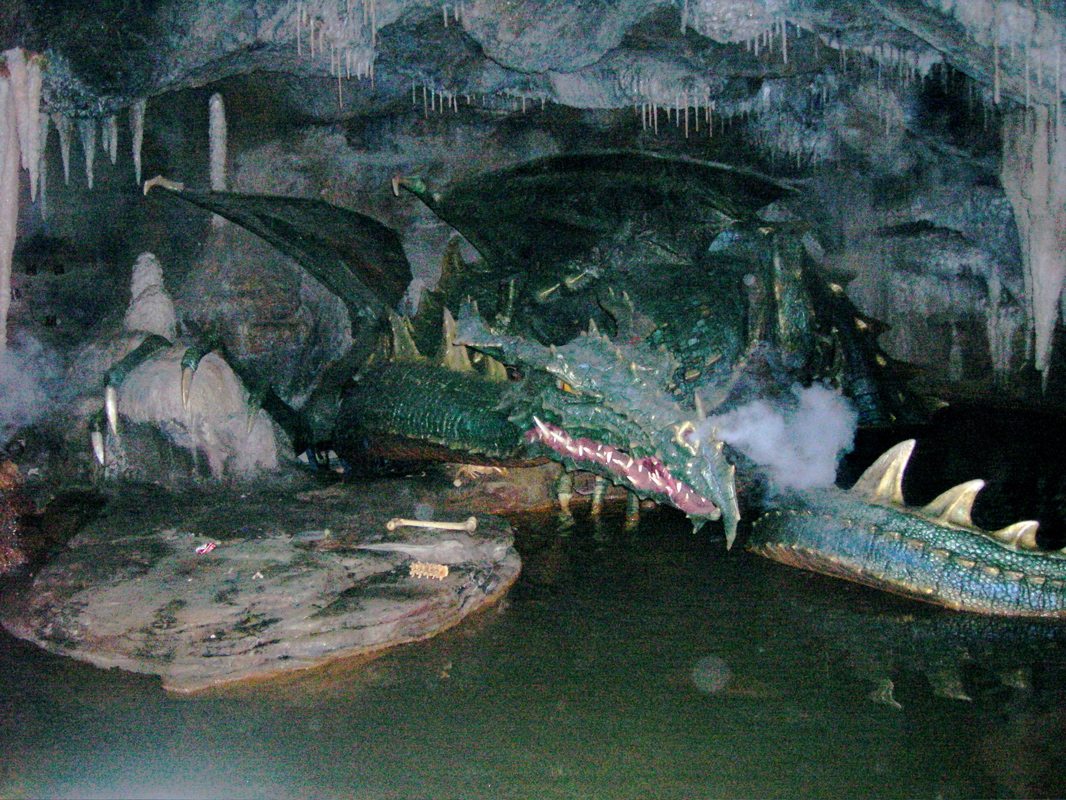
What I have seen in the dragon lurking beneath Sleeping Beauty's castle at Eurodisney, France. I don't know if this dragon was meant to be Maleficent or not. But it was, far and away my favorite part of the whole Eurodisney experience!

Smoke billowed from her nostrils. She turned her head and roared. She watched you with evil eyes, and you could see the bones of her victims beneath her snout. And, worst of all, the great chain binding her to the stone was broken. She hadn't noticed it yet . . . but how long? How long?

Loved it.

Maleficent has also been featured in the famous video game series, Kingdom Hearts, in which she plays a major antagonist's role.


A live-action film titled Maleficent staring Angelina Jolie is rumored to be in the works. This will be a retelling of Sleeping Beauty from the perspective of Maleficent.


Not sure how I feel about this. A sympathetic Mistress of All Evil is simply not as wonderful or interesting to me. But I'll be curious to see it in any case. Tim Burton was rumored to be set as the director, but it sounds like he's going to back out, leaving a directorial slot available to some hopeful.

Most recently, Maleficent has found her way into TV land via the ABC series, Once Upon a Time. Kristin Bauer plays her:

This does not impress me.

Where is the dignity or majesty? In the short clip I saw a few weeks ago of Maleficent's big scene, the actress played up the camp, and the script was as sad as it could be. The TV show might be wonderful (I hear people telling me all the time that I would love it), but if they can't handle their villains with appropriate dignity, what can they handle? I mean, she has a small black unicorn for a pet rather than her terrify trademark crow! I mean, really . . . a small black unicorn?


Yet again, I must ask: How are the mighty fallen?

This in no way damages the awe of the original Maleficent for me, though. She will live on in my imagination as the pinnacle of dragonishness and the great inspiration of all who aspire to write sinister dragons into their fairy tales!


Maleficent on a scale of 1-10


Evil:  10
The Mistress of All Evil rates a perfect score here, of course.

Scariness: 10
Terrifying! Marvelously so! She frightened me to the point of flee-to-grandma's-arms panic when I was little, and I have loved her for it ever since.

Poison: 8
Look at the green in her flames. How can that be anything but poisonous?

Hoard: 0
She lives in a dark and dreary castle in the farthest remote of remote farthests. No sign of any treasure or even a tapestry or two to lighten the mood.

Cleverness: 7
Can't give her much more than that. I mean, her vengeful curse on the princess was pretty diabolic. And she did carefully plan to kidnap Prince Philip to prevent him from thwarting her scheme . . . but, being the dreadful villainess that she is, she let villainy get in the way of practicality. Wanting to draw out Philip's torment, she didn't kill him right away, but merely locked him in her dungeon.

Let that be a lesson to all you villains out there. Kill them right away. Otherwise, they will escape and slay you. Trust me. It will happen.

Anyway, ladies and gentlemen, we have come to the final Tuesday of 2011, and this is the last of my Tuesday's Dragons. It's been a lot of fun! I've enjoyed all the research and hope you have enjoyed reading what I've learned. Happy reading and dragon-slaying!